
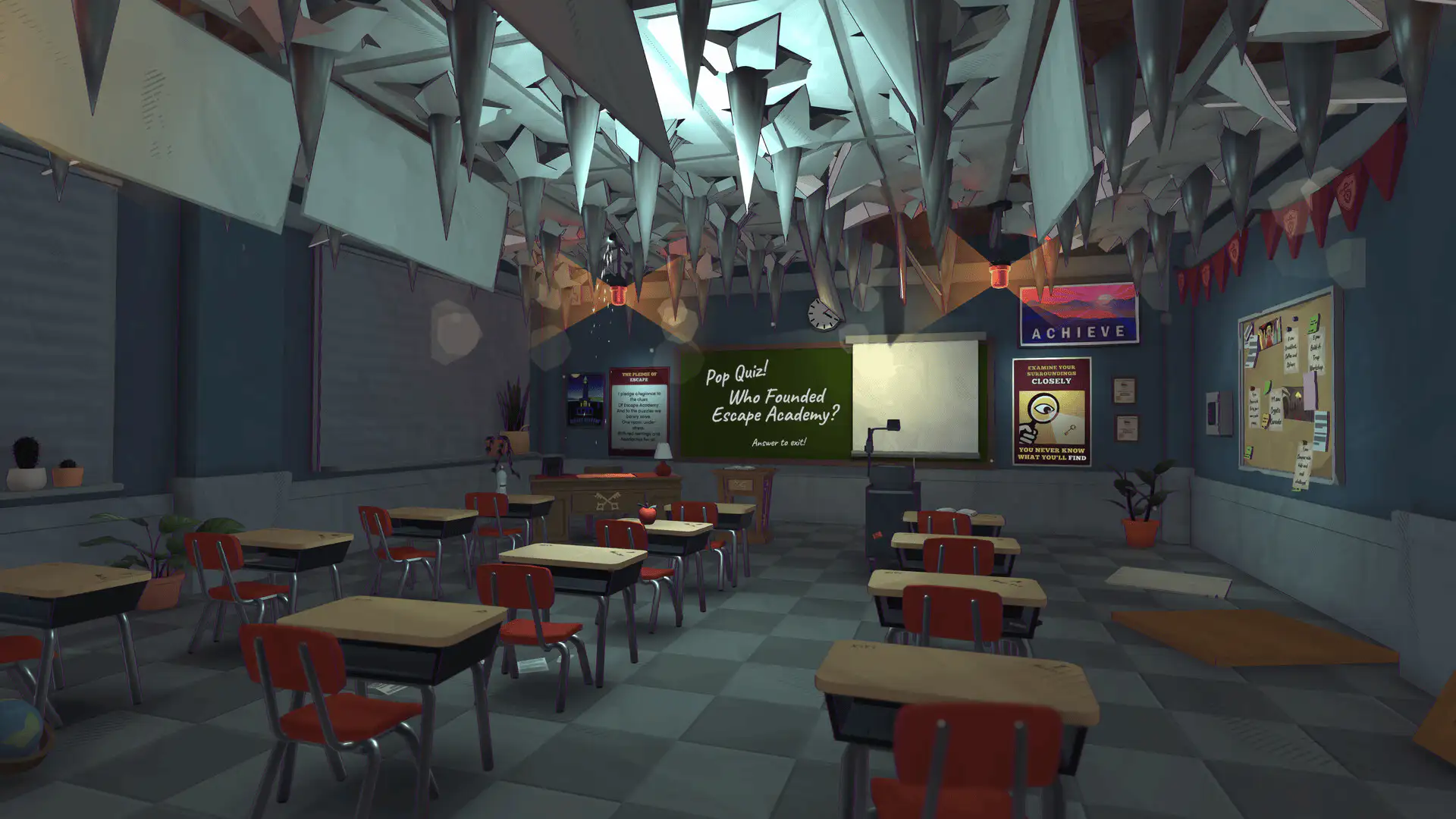
Official screenshot · Coin Crew Games / iam8bit Presents · Illustrative game media.
Recognize the classroom's central puzzle
The room presents a pop quiz about the Academy's founders, with evidence distributed across the classroom. Projector slides, schedule information and suit symbols contribute to that quiz rather than existing as unrelated decoration. Understanding that common purpose makes it easier to recognize why obtaining another slide moves the escape forward.
The developer's room introduction places the classroom under a falling-ceiling premise and explains its position after the tram tutorial. That is why the station's transport puzzles and the classroom's founder questions should be treated as separate escapes. If your current objective involves a tram ticket or a coloured destination map, start with No Ticket instead of applying the classroom logic too early.
Begin with the schedule's chronological order
Both captioned demo references show a schedule puzzle in which activities are matched in chronological order. Read the schedule as an ordering problem and identify the activity information available in the room. The useful connection is between the order you establish and the instruction it reveals, rather than an arbitrary guess at the final exit quiz.
One recording explains this stage around 05:45–06:38, while the June recording reaches its classroom work after 10:23. Those positions refer to different playthroughs, so matching them by timestamp alone can be confusing. Compare the schedule, room and object being used to decide whether you are following the same part of the escape.
Follow the telephone instruction
After the schedule work, both recorded sessions show the player using 772 on the telephone. The January co-op recording reaches that instruction around 06:44–06:55, and the June recording's captions state it around 16:30. Agreement between those sessions supports presenting it as a documented demo clue rather than as a number inferred from one failed attempt.
Treat the telephone step as part of the clue chain leading toward additional slide information. It does not replace the founder-and-suit reasoning required by the classroom's quiz. Because the developer later revised the room's clueing, the written or visible instruction in the installed build remains the immediate reference for the input you should use.
Collect and use the projector slides
The two playthroughs show retrieving slides and using the classroom projector to learn about the founders. Each slide contributes evidence to the room's larger question, so obtaining one is meaningful only when you read what it adds. Keep the projected information associated with its founder rather than blending details from different slides together.
The schedule and telephone progression helps explain how the room reveals more of that information. If you have followed the telephone clue, return your attention to the evidence that step provides instead of jumping straight to an unrelated final answer. The room is built around connecting those discoveries, and the quiz is the point where those connections matter.
Relate the founders to their suit symbols
The classroom's founder clues use suit symbols as identifiers that connect the projected evidence to the quiz. Match the information shown in your own room with the corresponding symbol before committing an answer. This keeps the solution grounded in visible relationships rather than in a list of names transcribed from automatic captions.
The source notes deliberately exclude exact founder-name spellings that were not consistently checked. Read those names directly in the game, where the spelling belongs to the actual puzzle presentation and language version. The verified mechanism is the connection between founder evidence and suit symbols, which remains more useful than an unreliable transcription of a proper noun.
Use the exit quiz to combine the evidence
The final quiz draws together what you learned while investigating the room and viewing its slides. Return to the founder-and-suit matches when deciding which response belongs to each question. The task is to apply the evidence collected through the escape, rather than treating the final interface as a new puzzle disconnected from the classroom.
The recorded research does not establish a complete current-build exit entry or a universally applicable desk-lock input. That prevents a responsible guide from replacing the quiz with an invented sequence. What it does establish is the route through schedule ordering, the telephone instruction, slide collection and founder identification that gives the quiz its context.
Account for the October clue changes
Coin Crew Games' October 16 demo update explicitly includes A Clued Awakening among the rooms receiving revised clues and user-experience improvements. That explains why an earlier video can show a slightly different presentation while still demonstrating the same classroom theme. Check which visible instruction your version provides before following an older recording literally.
Use the January and June footage to understand the reasoning that joins the room's objects, not as proof that every later input is unchanged. The developer update is the stronger source for the fact that clue presentation changed before launch. Keeping both pieces of information together lets you use the older demonstrations without mislabelling them as a tested launch-build solution.
Keep a compact record of the founder evidence
For a personal clue note, keep each founder's displayed information beside the suit symbol associated with it. Separate that evidence from the order of the schedule puzzle, since both contribute to the room but describe different relationships. This gives you a clear way to return to the projected material when the exit quiz asks you to combine what you have discovered.
Read names and written details directly from your installed game rather than relying on an automatic transcript. The collected captions are useful for confirming that the players use the schedule, telephone and projector, but not every proper-name spelling is independently established. A note copied from the actual slide preserves the information relevant to your language and version without introducing a guessed character name.
Use the telephone clue without skipping the reasoning
The documented 772 instruction belongs to a chain that starts with the chronological schedule and leads onward to slide information. Knowing the number does not, by itself, establish the final founder matches or answer the exit quiz. Treat it as help at a particular obstacle while still reading what the following interaction reveals about the room's central question.
If your version presents the clue differently, compare the relationship between the same objects before assuming the entire room has a new objective. The developer explicitly revised clue presentation in October, so the older demonstration and current instruction can differ without changing the founders theme. That is why the room explanation keeps the reasoning and the build context together instead of presenting one old input as the whole solution.
Continue through Chapter 1 after the classroom
In the chaptered May demo reference, A Clued Awakening begins at 13:26 and Student Orientation is marked at 20:11. That places the classroom before the campus activities and the later Clocktower escape. These chapter positions identify the recording's structure and should not be mistaken for a clear-time requirement or an A+ target.
Once the classroom's objective is finished, follow the first-chapter route into orientation and the campus rather than reusing its suit clues in the next room. That Rings a Bell introduces seasonal mechanisms, clock perspective and bells, which are separate puzzle relationships. Use the walkthrough hub for sequence questions and the Clocktower page when the tower's mechanisms become your actual obstacle.
Sources & research context
Based on the keyword research checked November 4, 2026. Demo observations and development-preview figures are labelled in the text; store and release statements retain that research date.