
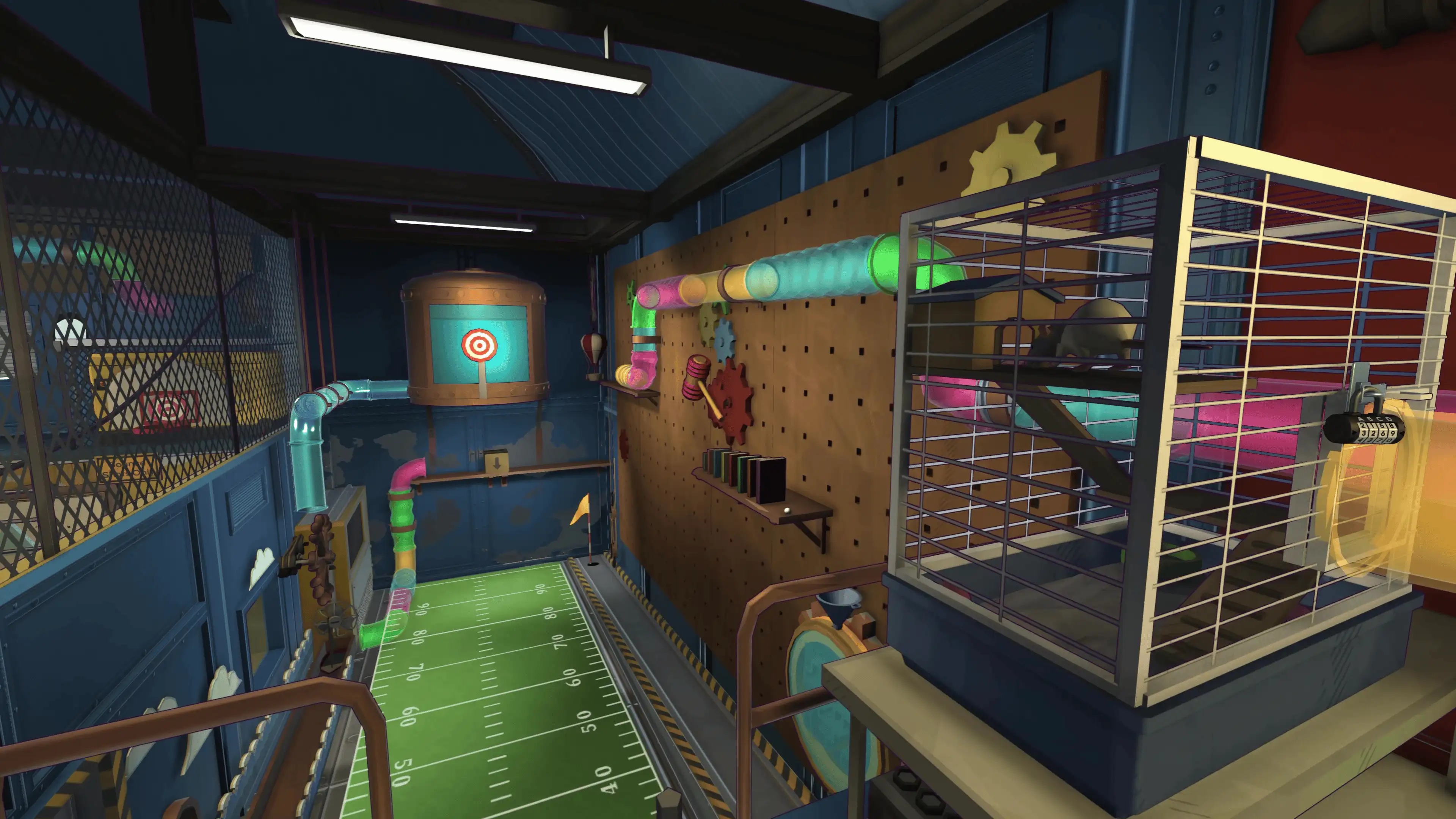
Official screenshot · Coin Crew Games / iam8bit Presents · Illustrative game media.
Identify That Rings a Bell before using a solution
That Rings a Bell is the named Clocktower exam, with a route that leads upward toward ringing the bells. The developer introduced the room in its January 23 devlog, and the refreshed demo places it later in Chapter 1. This identifies a particular escape rather than every task around a tower-shaped campus building.
The distinction matters because the demo also includes the Headmaster's Tower area and orientation activities. A player looking for a campus objective may therefore use the word tower without having reached the clock mechanisms. Match the room name and the visible seasonal or clock clues before treating this page as the solution to your current obstacle.
Match the season labels with the sun positions
For the seasonal puzzle, focus on the sun's position or height on the labelled mechanisms and compare it with the season information on the box. The developer's Steam reply specifically corrects a player's interpretation of this relationship. It explains the intended clue in terms of positions, rather than asking you to read the mechanism as an unexplained numerical combination.
Read each season label beside its own sun representation instead of separating the labels from the objects they describe. Then compare that pairing with what the receiving box communicates. This keeps your reasoning tied to the current display and avoids importing a gear arrangement from footage whose visual presentation may differ from your installed demo.
Understand why older sun-ring footage can differ
A second developer reply, posted during June demo feedback, addresses the appearance of the sun rings. It describes a visual adjustment intended to make the mechanism's rings agree more clearly with the box. That is useful context when the intended matching rule seems clearer than the graphics shown in an older recording.
The October 16 update later names That Rings a Bell among the rooms with revised clueing and user-experience work. Read those announcements together when comparing May or June gameplay with a newer installation. The stable explanation supported by the developer is the relationship between the labelled season and the sun position, while the current picture should guide the specific setting.
Read the clock from inside the tower
The apparently reversed Roman numerals are explained by the developer as a consequence of seeing the clock from behind. This is an orientation clue, so begin by understanding which side of the face you are viewing. Treating the numerals as a scrambled sequence creates a different problem from the one the room is presenting.
Keep your viewpoint consistent when relating the clock to its other clues. An outside-facing clock and an inside view of the same structure do not present the face in the same orientation. The developer's clarification gives a concrete reason for the reversal and removes the need to invent a separate rule for rearranging the numerals.
Connect the lens to the clock-and-letter clue
The later clock-and-note portion uses a lens to connect what you see on the clock with a letter clue. Read the objects as parts of one relationship, with the lens providing the view needed for that connection. The inside-the-clock perspective remains relevant when deciding how the reading corresponds to the note.
The captioned June session also refers to lens and crank requirements while the players progress through the tower. Those references establish the objects involved without turning every attempted move into a verified answer. Use the room's actual clock view and note as the immediate evidence, rather than copying a failed trial from the recording.
Separate the telescope model from the sun mechanism
In the additional demo-feedback reply, the developer explains that the telescope model represents a moon and shaped meteors. That clarification concerns a particular model and helps prevent it from being confused with the seasonal sun rings. Read the object you are observing according to its own clue context before applying a rule learned at a different tower mechanism.
This is especially important in a room where several astronomical and clock-related objects appear in the same space. A shared visual theme does not make every object part of the same input. The developer's separate explanations for sun position, the telescope model and clock perspective show why identifying the mechanism comes before trying to solve it.
Use video references for the relevant stage
The May 30 Chapter 1 video marks That Rings a Bell at 1:07:42, giving a clear place to find the Clocktower portion. The June captioned playthrough reaches the seasonal and later tower mechanisms around its own 1:10–1:20 segment. These are recording navigation aids, not a completion-time target for your attempt.
Watch for the same labelled mechanism or clock viewpoint that appears on your screen, and distinguish explanation from experimentation. The June players make unsuccessful trials, including during the bell stage, so their actions are not automatically a solution sequence. The developer's clarification is the stronger basis for the intended seasonal and perspective logic.
Keep each mechanism's evidence together
Make separate notes for the season-and-sun relationship, the inside-clock viewpoint and the lens-and-letter connection. These ideas appear in one escape but do not represent interchangeable instructions for a single input. Keeping each observation beside the object it describes helps when a recording moves quickly between mechanisms or includes a player discussing several possible interpretations at once.
For the seasonal section, record the labels and positions as they appear in your installed build. For the clock section, record which side of the face you are viewing before interpreting the note. Those are practical ways to apply the developer's clarifications without inventing a universal arrangement, a final bell sequence or a numerical shortcut unsupported by the source.
Choose a hint by the clue causing confusion
If the problem is that the seasonal graphics appear inconsistent, begin with the sun-position explanation and the later clue-update context. If the problem is the direction of the Roman numerals, begin with the developer's behind-the-clock perspective. If the problem is understanding the note, relate that reading to the lens rather than applying the seasonal rule to a different mechanism.
This gives you a route through the documented points of confusion without pretending every floor has been independently cleared in the current build. The developer replies resolve specific interpretations, while the gameplay references show the setting and sequence in older demonstrations. Use each kind of source for the question it actually answers, then return to the visible room clue before entering an input.
Approach the bell stage without a fabricated melody
Ringing the bells is part of the room's stated objective, but the collected research does not establish a universal final melody or a complete current-build rope-and-constellation sequence. Follow the clues your installed room presents as you reach those interactions. The verified help here is the season matching, object context and clock perspective that resolve specific documented points of confusion.
For questions about getting to this room, use the demo-tower article; for the chapter's earlier rooms, return to the walkthrough hub. Keeping access and orientation separate from mechanism reasoning makes it easier to choose the relevant hint. The related pages connect those stages without claiming that an untested list of inputs is a complete Clocktower clear.
Sources & research context
Based on the keyword research checked November 4, 2026. Demo observations and development-preview figures are labelled in the text; store and release statements retain that research date.
- Coin Crew Games · That Rings a Bell · Devlog 8 ↗
- Developer reply · Clocktower perspective and seasons ↗
- Developer reply · Sun rings and telescope model ↗
- Coin Crew Games · Demo Update · October 16, 2026 ↗
- Fredericma45 Gaming · Chapter 1 demo · May 30, 2026 ↗
- The Feral Viola · Captioned demo playthrough · June 24, 2026 ↗