
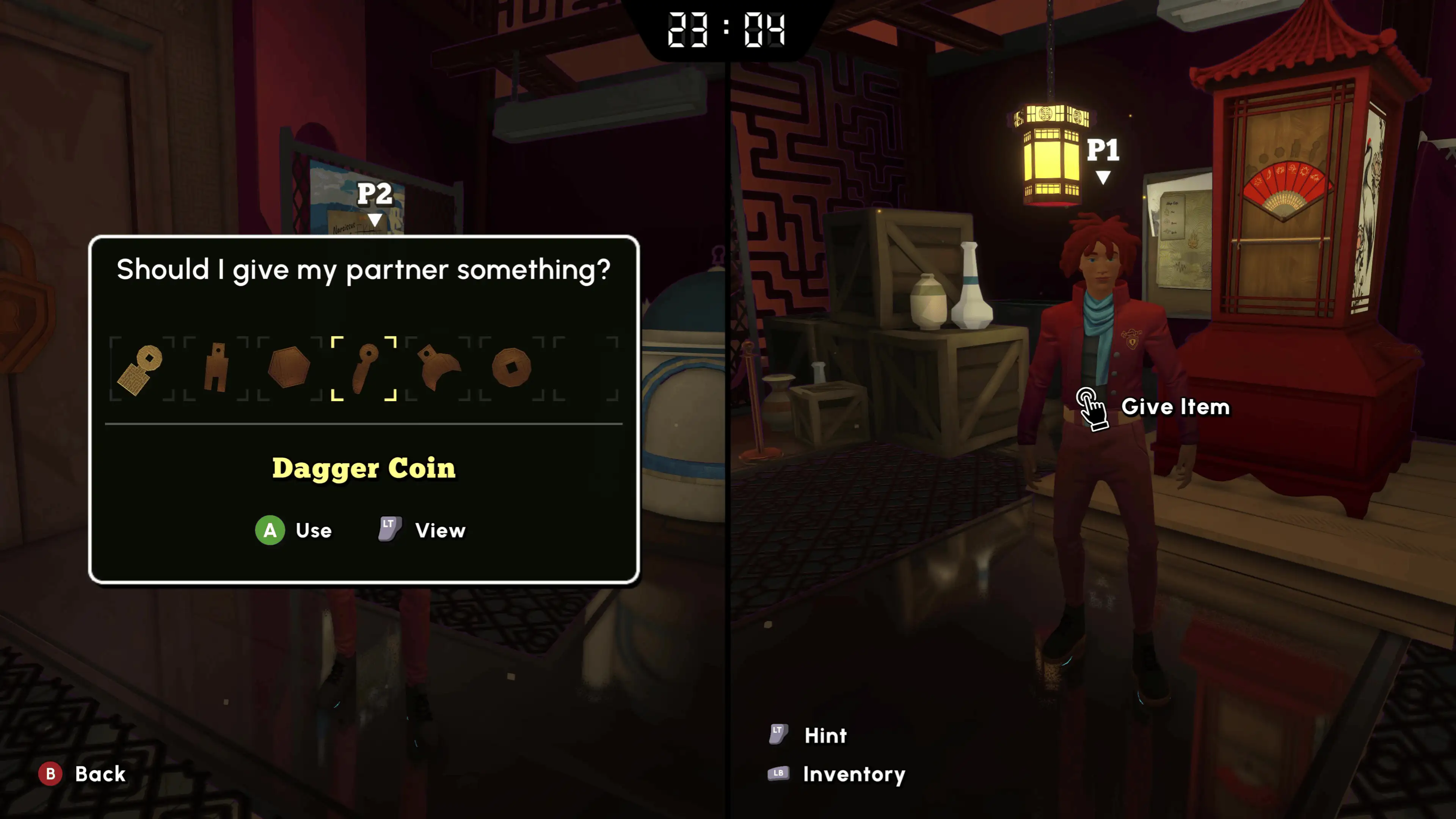
Official screenshot · Coin Crew Games / iam8bit Presents · Illustrative game media.
Understand what Extra Credit adds
Extra Credit expands campus life beyond the main escape rooms, giving students and other activities a role in progression. The developer's quest posts distinguish main objectives from side activities while explaining why the latter have meaningful rewards. That makes the system part of exploring the Academy rather than a separate set of unrelated challenges.
The central practical connection is money: participating in campus tasks earns resources for things the story asks you to buy. That does not turn every available activity into a mandatory story step. It gives you a choice of ways to earn funds while the main objective remains a distinct part of your journal and overall route.
Separate the main objective from a campus task
Keep a named main escape or story purchase distinct from the side activity used to help fund it. The developer's first quest devlog explains the main-and-side split, and the later Extra Credit post describes the partial participation needed for progression. Together, they explain why earning money can matter without requiring a complete side-quest checklist.
If your immediate aim is to continue the story, identify the actual purchase or objective before deciding which campus task to tackle. Completing a small activity can be useful because of its reward even when its own story is separate from the next escape. This is a clearer way to read progress than assuming every visible student request must be finished in a fixed order.
Use the journal to track your activities
The hands-on material collected for this topic describes the journal as a way to track campus tasks. Use it to distinguish the activity you are currently following from another request encountered while exploring. Keeping the wording of the objective in view also makes it easier to recognize whether a clue belongs to the main route or a side activity.
When making personal notes, record the task's campus context and the specific obstacle you are trying to resolve. That prevents a cash-related objective from being confused with a collectible goal or a main-room lock. The journal's role is organization, while the activity's own clues still provide the information needed to complete it.
Choose tasks that help fund progression
Extra Credit rewards Escape Bucks, and the economy research identifies class books as important story-related purchases. This gives the side activities a concrete purpose when money is the reason you cannot move forward. Look for an available campus task you can work through, then use its reward in the context of the purchase you are pursuing.
The research supports choice among activities rather than one universal required farming route. It does not establish that a particular task gives the best reward per minute or that repeating it creates unlimited money. Choose by the task you can identify and solve, while using the Escape Bucks page to understand the distinction between earning, spending and other progression systems.
Recognize the developer's example activities
The developer officially describes feeding a cat, the Clown Club and a returning Rubik's Grid moved into side content. These examples show that Extra Credit can involve different kinds of campus interactions rather than one repeated puzzle format. They are useful names to recognize while comparing the journal with the activities you discover.
Treat the examples as illustrations of the system, not as a complete final list or a prescribed completion order. The May preview described more than 20 quests during development, but that dated count is not an audited launch checklist. The useful information is the range of activities and their place in the campus economy, without converting a preview total into a completion requirement.
Understand how side content fits exploration
Review material describes cash-paying side puzzles alongside the main escape rooms and the Academy's broader exploration. Students can offer small tasks, while other activities are encountered around campus. This explains why moving through the hub is part of the game's rhythm rather than simply the empty travel between formal exams.
Use campus exploration to discover activities, then return to the journal when you want to focus on one. A review mentions a recurring Sudoku-style activity using number and letter information, but that description is not a verified answer grid. Solve the clue in front of you rather than assuming a broad description supplies every activity's final input.
Keep Extra Credit, fish and currency distinct
Extra Credit is the side-activity system, Escape Bucks are the money it can pay, and Red Herrings are collectible fish with their own turn-in goal. These concepts can overlap during exploration without becoming interchangeable. Finishing a cash task should not be recorded as finding a fish, and collecting a fish should not be counted as a specific amount of money.
The distinction also helps with achievement planning, where side activities and collectibles can contribute to different targets. Use the achievements page to identify the listed condition, then follow the appropriate system guide for that activity. This avoids treating every campus interaction as a generic percentage of story completion or inventing a reward the source never confirms.
Read a task's purpose before choosing it
When reviewing your journal, separate the request itself from the reason you want its reward. A small campus activity can be worth pursuing because it supplies money for a story-related purchase, even when it is not the next main escape. That distinction helps you choose a useful next task without assuming the journal must be cleared from top to bottom before continuing.
The developer's examples show variety rather than a single mandatory format, so use the actual task description to recognize the kind of clue involved. Feeding a cat, Clown Club activity and Rubik's Grid are identified examples, not evidence that every task uses the same input. Keep each activity's own instructions beside its objective rather than importing a solution from another campus puzzle.
Keep completion goals separate from story access
The main story's partial need for Extra Credit earnings and an achievement-related completion goal are different reasons to engage with side content. A player pursuing the next purchase may choose among available activities, while a completion-focused player has a broader objective. The achievements guide explains those listed target groups without treating the May development preview as a final all-quests checklist.
This makes the wording of your own goal important when deciding what to do next. Earning enough for a purchase, finishing a named request and pursuing wider campus completion are related activities but not identical endpoints. Use the journal and the actual listed condition to keep those endpoints clear while choosing from the side content you have encountered.
Decide what to do next when the story stalls
If the blocker concerns a purchase, check the Escape Bucks guide and look for a journal-tracked activity that earns money. If the blocker is a specific escape-room mechanism, use the walkthrough hub and the named room guide instead. That separates the economic reason to explore from the puzzle reasoning needed inside an exam.
If your goal is broader completion, revisit Extra Credit as its own part of campus progress rather than assuming the story required you to finish everything already. The collected sources establish the system and examples, not every final unlock condition or reward. Work from the tasks your journal actually shows and keep the main objective visible while choosing your next campus activity.
Sources & research context
Based on the keyword research checked November 4, 2026. Demo observations and development-preview figures are labelled in the text; store and release statements retain that research date.